Tile quantity guide
How Many Tiles Do I Need?
To find out how many tiles you need, divide the area being tiled by the area of one tile, add an appropriate waste allowance, round up to a whole tile, and then account for how the product is packaged in boxes.
That is the tile calculation formula in one sentence. Square footage (or square meters) tells you the coverage. Tile size tells you how much area each piece covers. Waste covers cuts, breakage, and a few extras. Boxes matter because you usually cannot buy a fraction of a carton.
How to Calculate How Many Tiles You Need
Use these five steps for floors, walls, showers, and backsplashes. The Tile Calculator follows the same order.
- Measure the area. For a rectangle, multiply length by width. For an L-shaped or irregular room, split the space into rectangles and add those areas.
- Calculate tile area. Convert the tile size into the same units as the room, then multiply tile length by tile width.
- Divide total area by tile area. That gives the tiles needed before waste.
- Add a waste allowance. Waste is a planning estimate for cuts, obstacles, offcuts, breakage, and later repairs.
- Round up and account for boxes. Round up to a whole tile, then round up again to complete boxes if the tile is sold by the carton.
Tile area
Tile area (sq ft) =
(tile length in inches ÷ 12) × (tile width in inches ÷ 12)
Tiles needed
Tiles needed = Total area ÷ Tile area
Tiles to buy
Tiles to buy = Tiles needed × (1 + waste %)
Round the result up. Then check tiles per box or coverage per box so you buy complete cartons.
Example: How Many Tiles Do I Need for a 10 × 12 Foot Room?
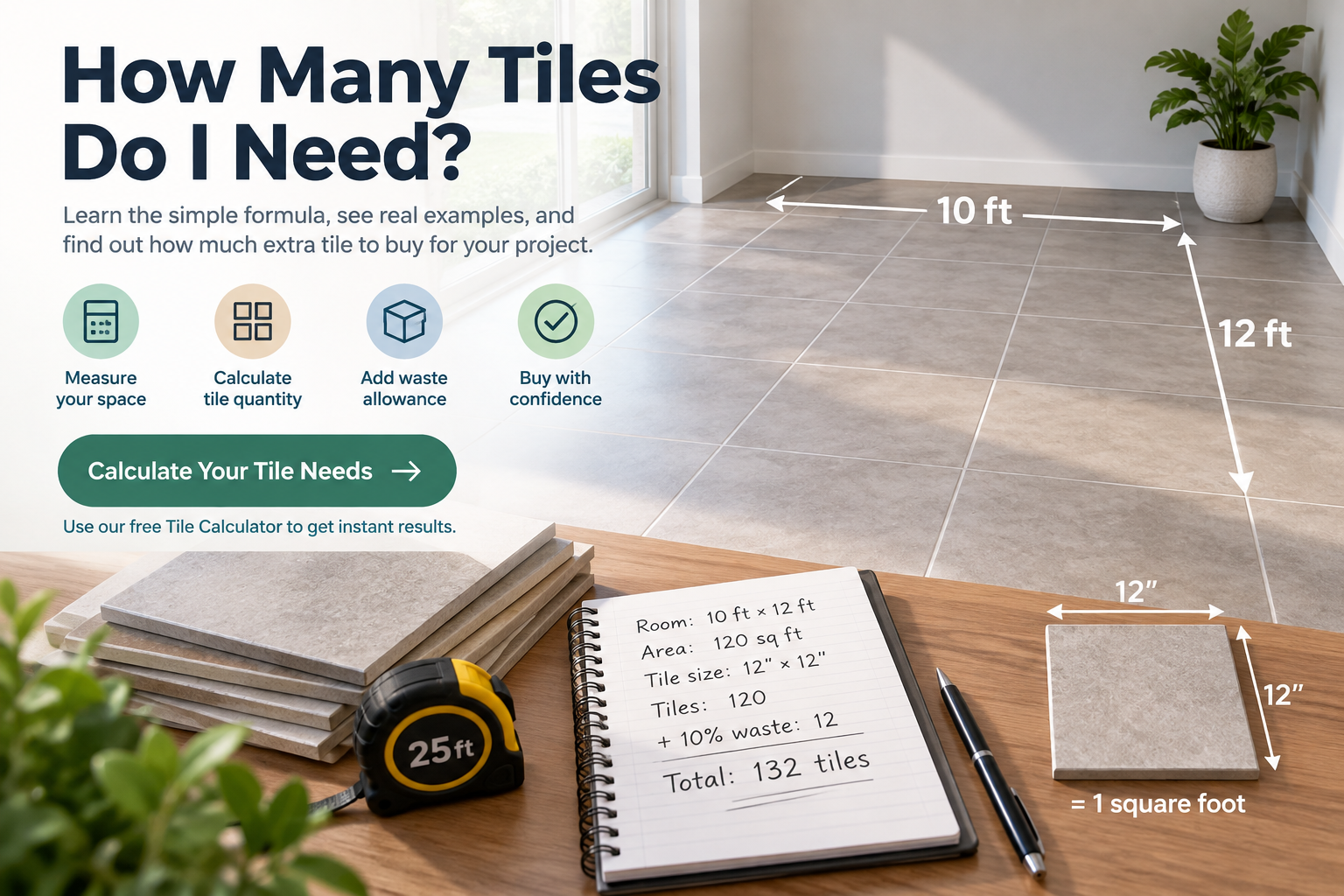
A 10 ft × 12 ft room is a common floor example. With 12 × 12 inch tile, each tile covers 1 square foot.
- Room
- 10 ft × 12 ft
- Area
- 120 sq ft
- Tile size
- 12 × 12 inches
- Coverage per tile
- 1 sq ft
- Tiles before waste
- 120
- Waste
- 10%
- Extra tiles
- 12
- Recommended
- 132 tiles
120 sq ft ÷ 1 sq ft per tile = 120 tiles. A 10% waste allowance adds 12 tiles, so plan to buy 132.
If you used 18 × 18 inch tile instead, each tile covers 2.25 sq ft (18 ÷ 12 = 1.5, and 1.5 × 1.5 = 2.25). 120 ÷ 2.25 = 53.33…, which rounds up to 54 tiles before waste. Then add your waste percentage.
How Much Extra Tile Should I Buy for Waste?
Waste (sometimes called overage) is a general planning guideline, not a guaranteed requirement. Actual waste depends on room shape, the number of cuts, obstacles, offcuts, breakage, and whether you keep extras from the same lot for later repairs.
- Simple straight layout Around 10%
- More cuts or obstacles Around 10–15%
- Diagonal layout Often 15% or more
- Herringbone or complex patterns Typical estimate 15%
Small rooms, lots of corners, and strong patterns can need more. Complicated layouts and extra cuts are why many people keep a little extra from the same production lot.
How Many Tiles Do I Need for a Floor?
For a rectangular floor:
Length × Width = Floor area
A 15 × 20 ft floor is 300 sq ft. With 12 × 12 inch tile, that is 300 tiles before waste. A 10% waste allowance adds 30 tiles, so you would plan around 330 tiles, then round up to boxes.
For an L-shaped or irregular floor, split the space into rectangles, measure each one, and add those areas before you divide by tile coverage. The calculator supports multiple areas, so you can enter each rectangle instead of forcing the whole room into one measurement.
How Many Tiles Do I Need for a Wall?
Wall tile uses the same idea:
Wall width × wall height = Wall area
If a door, window, cabinet, or niche will not receive tile, you can deduct that opening. The calculator’s Openings & deductions feature subtracts width × height × quantity from the total area before waste is applied. If you tile up to a window stool or around a door frame, measure only the surfaces that will actually receive tile.
How Many Tiles Do I Need for a Shower or Backsplash?
Showers and backsplashes are often several rectangles instead of one floor plane.
Shower tile
- Measure each shower surface (walls and, if tiled, the floor).
- Calculate each area.
- Combine those areas.
- Account for openings where they will not be tiled, such as a niche or door.
- Add waste. Niches, corners, and small cuts often need a higher allowance.
Backsplash tile
- Use width × height for the backsplash field.
- Account for meaningful cutouts, such as a window, if that area will not be tiled.
- Add waste for outlet cuts, edges, and pattern matching.
How Many Tiles Are in a Box?
There is no universal number of tiles per box. Carton size depends on tile dimensions, the manufacturer, the product line, packaging, and listed coverage per box.
Check the product packaging or specification sheet for tiles per box or coverage per box. Tile is usually sold by the carton, so round up to complete boxes. You generally cannot buy a fraction of a box.
Should I Account for Grout Joints?
Grout joints affect layout and the look of the finished surface. They should not automatically be treated as a fixed waste percentage, and they should not be double-counted on top of a separate waste allowance.
Common grout joint widths include 1/16 inch, 1/8 inch, 3/16 inch, and 1/4 inch. Record the planned joint for layout. The tile quantity estimate still uses tile size plus waste, not grout width as a substitute for overage.
What If My Room Isn't a Rectangle?
Divide an irregular or L-shaped room into rectangles, calculate each area, then add them together before you divide by the area of one tile.
- Rectangle A
- 10 × 12 = 120 sq ft
- Rectangle B
- 6 × 8 = 48 sq ft
- Combined area
- 168 sq ft
Enter each rectangle as a separate area in the calculator so the total coverage is combined before the tile count is calculated.
Quick Tile Calculation Examples
These examples all use 12 × 12 inch tile (1 sq ft each) and a 10% waste allowance.
| Area | Tiles before waste | 10% waste | Tiles to buy |
|---|---|---|---|
| 50 sq ft | 50 | 5 | 55 |
| 100 sq ft | 100 | 10 | 110 |
| 120 sq ft | 120 | 12 | 132 |
| 200 sq ft | 200 | 20 | 220 |
Imperial vs. Metric
Use one system for the room and the tile. Imperial uses feet and inches; metric uses meters, centimeters, and millimeters. Convert tile size into the same units as the room before you divide. The calculator’s Imperial/Metric switch keeps those labels aligned.
How Tile Cost Fits In
After you know recommended tiles, you can estimate tile material cost from price per tile, price per box, or purchase tile area × price per unit area. That estimate is for tile material only — not labor, thinset, grout, tools, or delivery.
Common Mistakes
- Forgetting waste, then rounding boxes from the bare tile count.
- Measuring an L-shape as one oversized rectangle instead of separate areas.
- Deducting openings you still plan to tile.
- Assuming grout joint width reduces the current quantity formula. In this calculator it is informational only.
- Treating the on-page pattern preview as a cut-accurate installation layout.
Frequently Asked Questions
How do I calculate how many tiles I need?
Measure each rectangle, multiply length by width, and add the areas. Divide that total by the area of one tile, round up to a whole tile, then add your waste percentage. The Tile Calculator on this site does those steps for you.
How much extra tile should I buy?
These are general planning guidelines, not a guaranteed requirement. The Tile Calculator suggests 10% for straight/grid, 12% for offset/running bond, and 15% for diagonal or herringbone. Actual waste depends on room shape, cuts, breakage, and whether you keep extras for later repairs.
How many 12×12 tiles do I need for 100 square feet?
A 12 × 12 inch tile covers 1 square foot, so 100 square feet needs 100 tiles before waste. With a typical 10% waste allowance, plan to buy 110 tiles.
Should I subtract doors and windows?
Yes, if those openings will not receive tile. Leave them out of the measurement, or use the calculator’s Openings & deductions feature so width × height × quantity is subtracted before waste is applied. If you tile up to a window stool or around a door frame, measure only the surfaces that will actually receive tile.
How many tiles are in a box?
There is no universal number. It depends on tile dimensions, the manufacturer, the product line, packaging, and coverage per box. Check the carton or specification sheet, then round up to complete boxes.
Do I need more tiles for a diagonal or herringbone layout?
Usually yes. Those patterns create more cut pieces, so the calculator’s suggested waste is 15% for both diagonal and herringbone as a planning estimate. Choose the matching pattern & waste estimate, or enter a custom percentage if your installer recommends one.
Can I calculate wall and shower tile?
Yes. Wall tile uses wall width × wall height. For a shower, measure each surface, add the areas, and deduct openings where they will not be tiled. Backsplashes use the same width × height approach. Then divide by one tile’s coverage and add waste.
Should I keep leftover tiles?
Yes. Keep extras from the same production lot for chips, future repairs, or matching a later patch. Shade can vary between production runs, so leftover tile from this project is more useful than a later replacement box.
Ready to run the numbers for your room? Use the Tile Calculator to calculate your tile quantity, waste, boxes, and estimated material cost.